Explore Crisil, a company of S&P Global
Formerly known as Global Research & Risk Solutions
June 08, 2026
 Blog
Blog
Blog
The hidden cost for asset managers
June 08, 2026
Blog
Blog
Companies are failing to add up the true impact of corporate action errors
 Share
Share



Scenario
A portfolio manager makes a rebalancing decision on Tuesday morning. The position data looks clean, and the analysis supports the trade. Three days later, during routine reconciliation, an analyst notices a stock split processed the previous week carrying an incorrect ratio in the security master. The position that informed Tuesday’s decision was wrong. The trade has settled; the cost is real and the audit trail uncomfortable. Nobody books this as a corporate action error. It surfaces as a reconciliation break, gets resolved and is filed.
By the numbers
Source: PGGM case study
Source: Total Economic Impact, 2024
The scale of the problem: A model built for a different world
For most of the industry’s history, corporate action processing worked well enough. Events were manageable in volume. Custodians sent notifications and operations teams reviewed them, calculated entitlements, updated records and moved on. That sufficiency has quietly eroded, driven by three structural shifts: a significant expansion in the number of globally listed companies, the explosion of exchange-traded funds (ETF) and passive investing strategies that multiplied the portfolio impact of every corporate event, and increasingly complex capital structure activity from corporations.
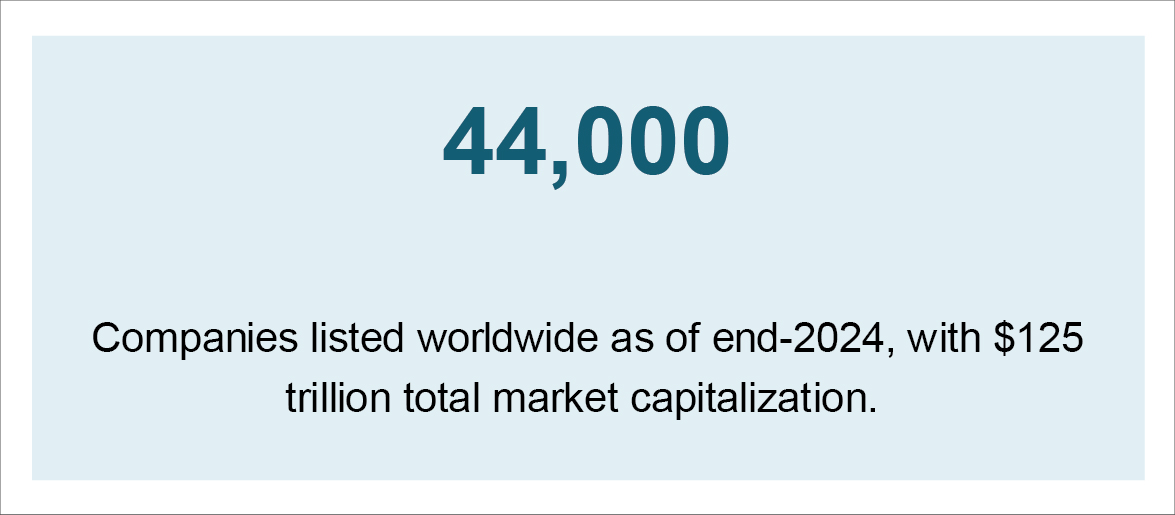
According to the Corporate Governance Factbook 2025, approximately 44,000 companies are listed worldwide with a total market capitalization of $125 trillion. The US accounts for half of that total by value, while Asia represents 58% of the listed companies by count. Each company generates its own corporate event calendar and each event triggers operational workflows across every asset manager holding that security.
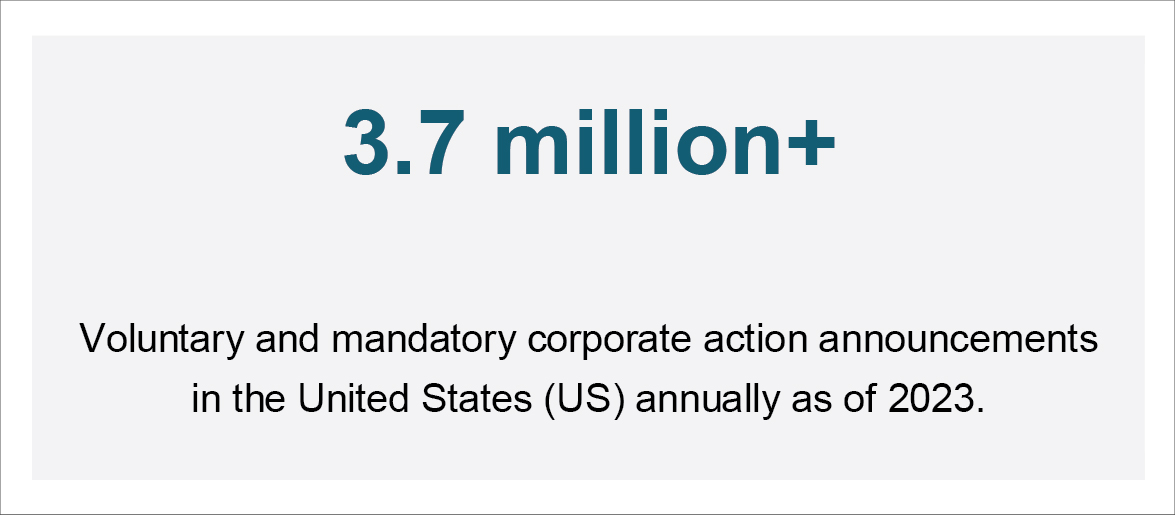
The central clearing and settlement infrastructure for US markets estimates over 3.7 million voluntary and mandatory corporate action announcements every year in the US alone (as of 2023). And that number has grown steadily.
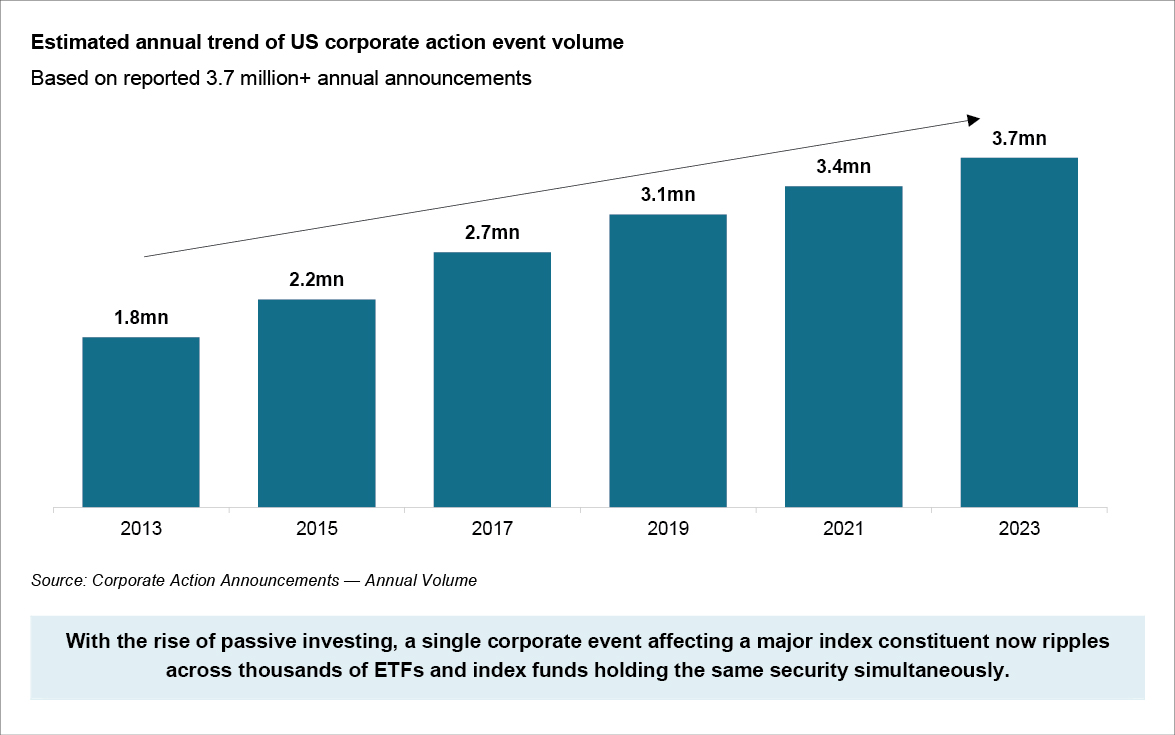
Financial impact: Where the cost actually lives
For most asset managers, the monetary impact of corporate action errors lands in four distinct categories, none of which typically interact with each other. This structural separation is precisely why the aggregate cost stays invisible.
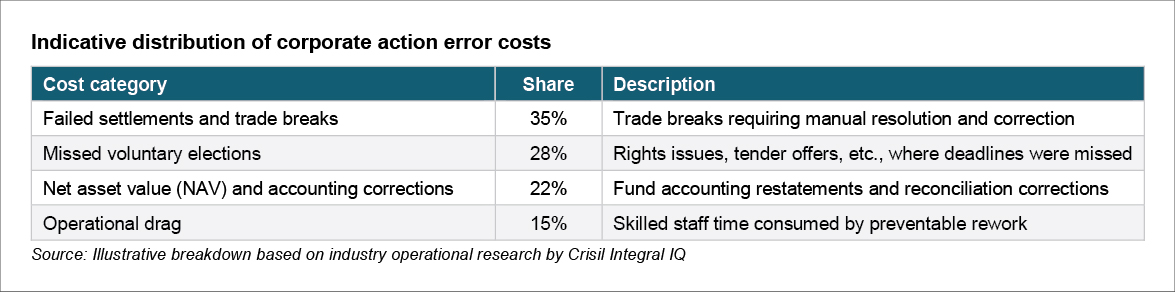
Three of these categories warrant closer examination as each represents a distinct cost that compounds differently across the investment operations.
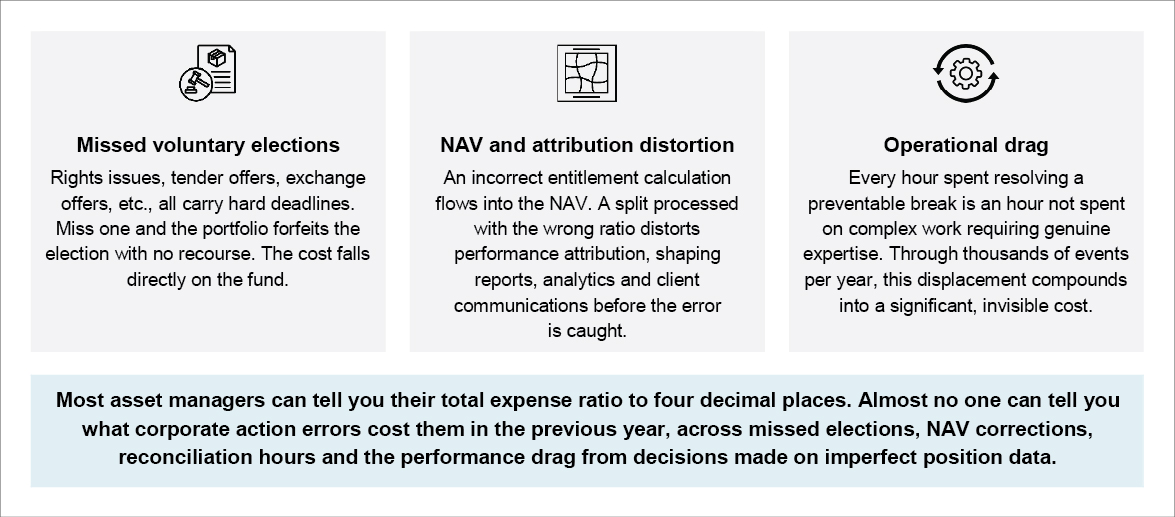
The architecture solution: Why adding to the headcount doesn't help
Corporate action processing is not a volume problem, but a data architecture problem. And the distinction matters because it determines what the solution looks like.
In a traditional model, a human touches every corporate action event. The staff reviews each notification, verifies terms, calculates entitlements and approves processing. This works at low volumes but becomes a bottleneck as volumes rise.
In an exception-based model, the architecture is inverted. Technology manages the bulk of the events automatically. Operations staff gets involved only when something falls outside the expected parameters, such as a genuine data conflict, an ambiguous event structure or a calculation the system cannot resolve with confidence.
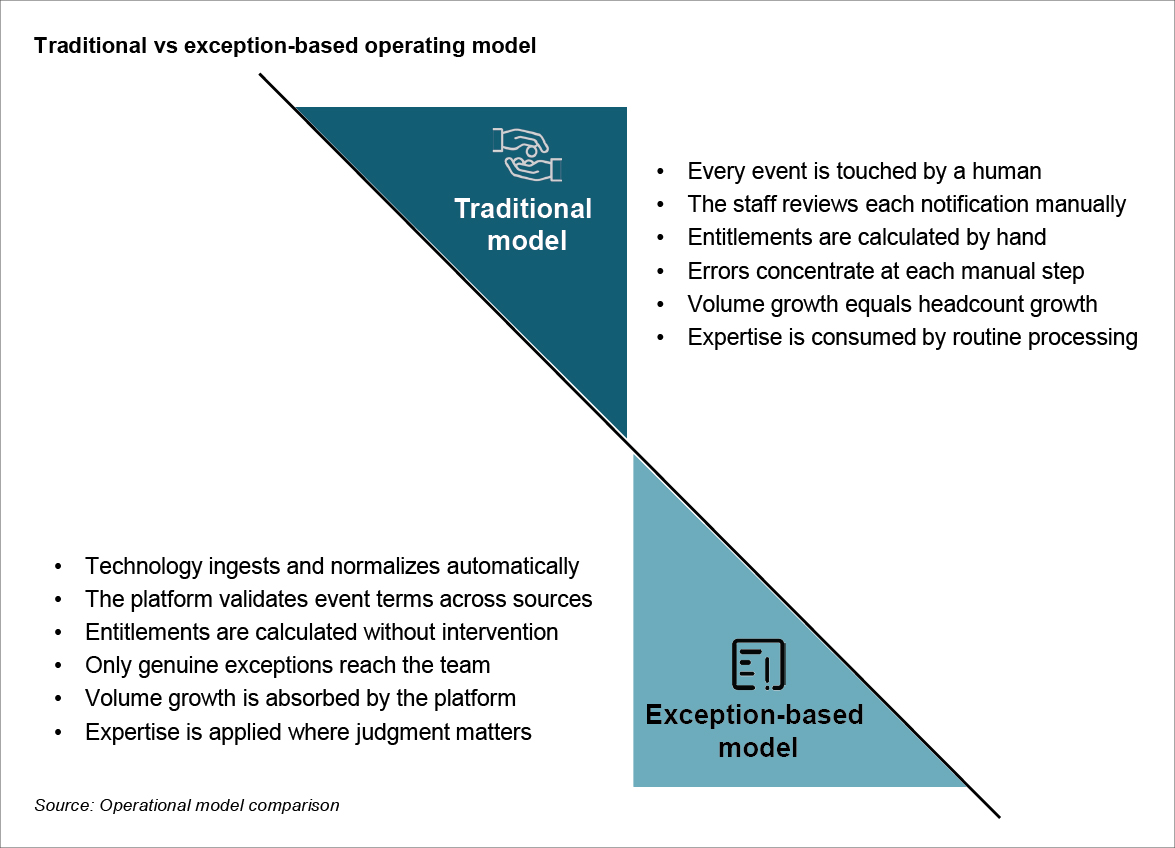
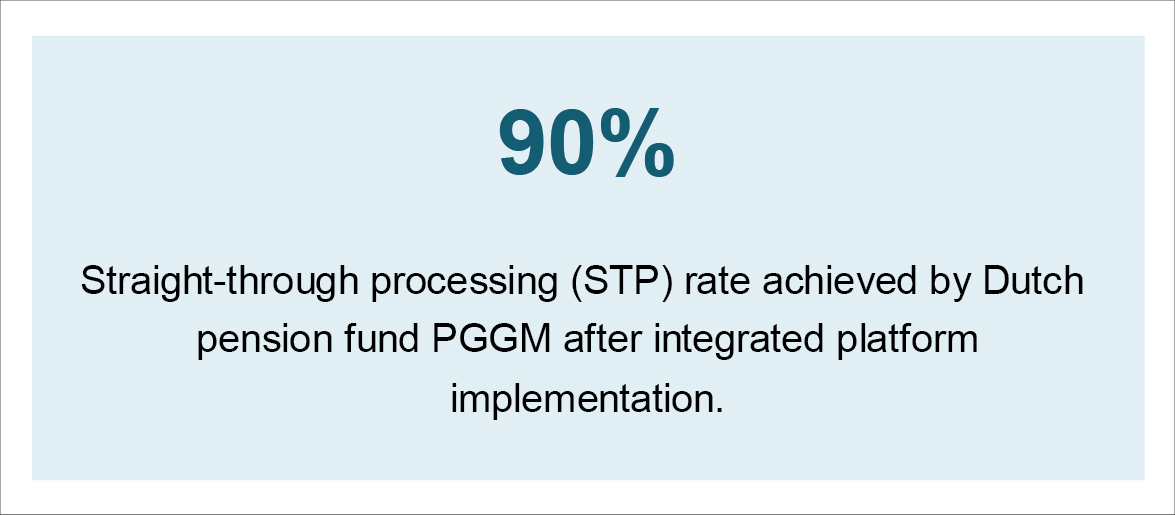
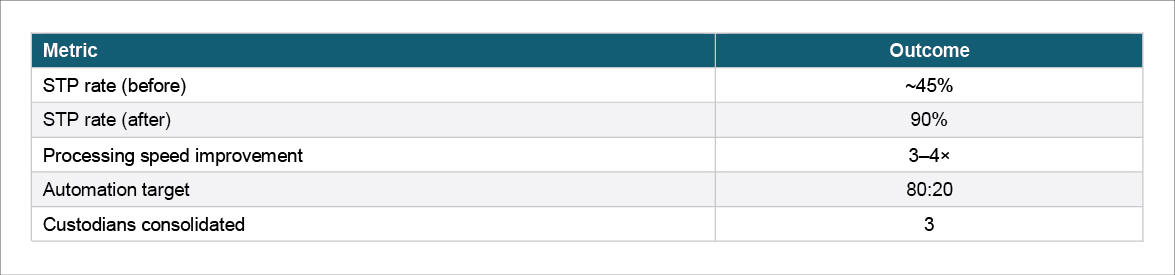
The exception-based model is the superior architecture and the evidence is unambiguous. The distinction is not simply about efficiency, but about where human expertise is applied. In the traditional model, skilled professionals spend most of their time on routine processing, leaving little capacity for events that require judgment. In the exception-based model, that ratio is inverted as technology absorbs the bulk of the volume and human expertise is reserved for decisions that genuinely warrant it. PGGM saw a 3-4 times speed improvement and 90% STP rate as a direct consequence of this architectural choice. The model doesn’t just work better; it scales up in a way the traditional model structurally cannot.
Documented outcomes: What getting it right looks like
The outcomes at firms that have rebuilt their corporate action architecture are documented and specific.
Case study: PGGM
Dutch pension fund service provider
PGGM implemented the Corporate Actions Manager platform in 2016, with 80% of the corporate action workflow fully automated and human attention reserved for the remaining 20% that required genuine judgment.

Case study: Achmea Investment Management
A company with assets under management (AUM) of €180 billion
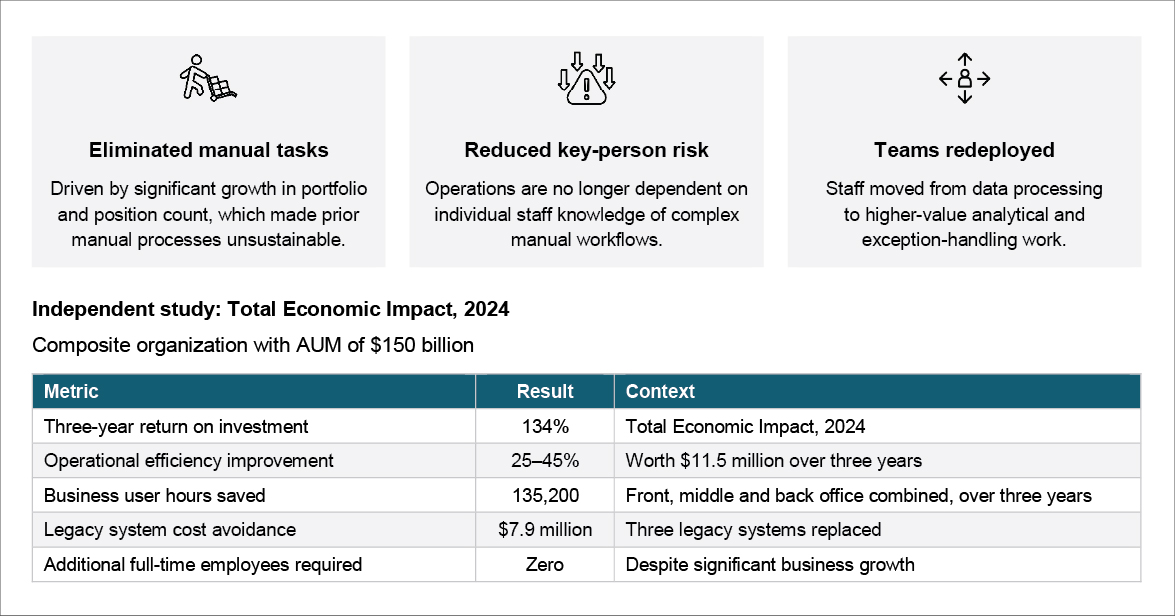
Achmea Investment Management faced a version of the problem many larger managers will recognize. Portfolio and position count had grown substantially and manual processes that were adequate at a smaller scale were generating compounding operational and key-person risks. The documented outcomes of its 2021 implementation of an integrated platform:
Strategic foundation: The compounding cost of waiting
Corporate action data is not an isolated input, but a foundation. Every layer of investment operation depends on what sits beneath it and every error in the foundation propagates upward through the entire stack.
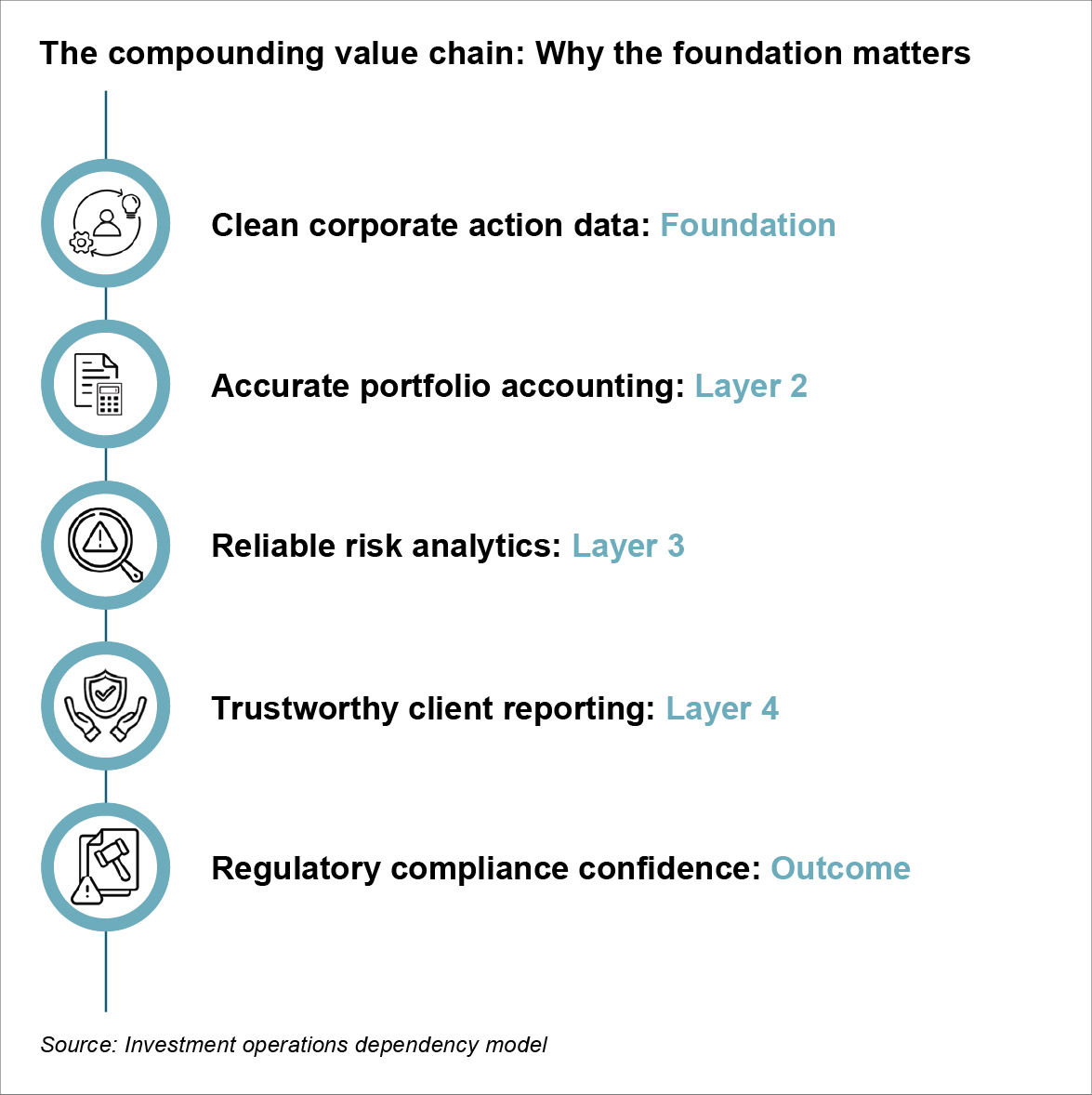
The firms that treat corporate action data quality as a strategic foundation build something that pays returns across their entire investment function. The firms that do not are accumulating a gap between the volume and complexity of the problem they face and the capability of the model they are running to manage it. That gap grows every year.
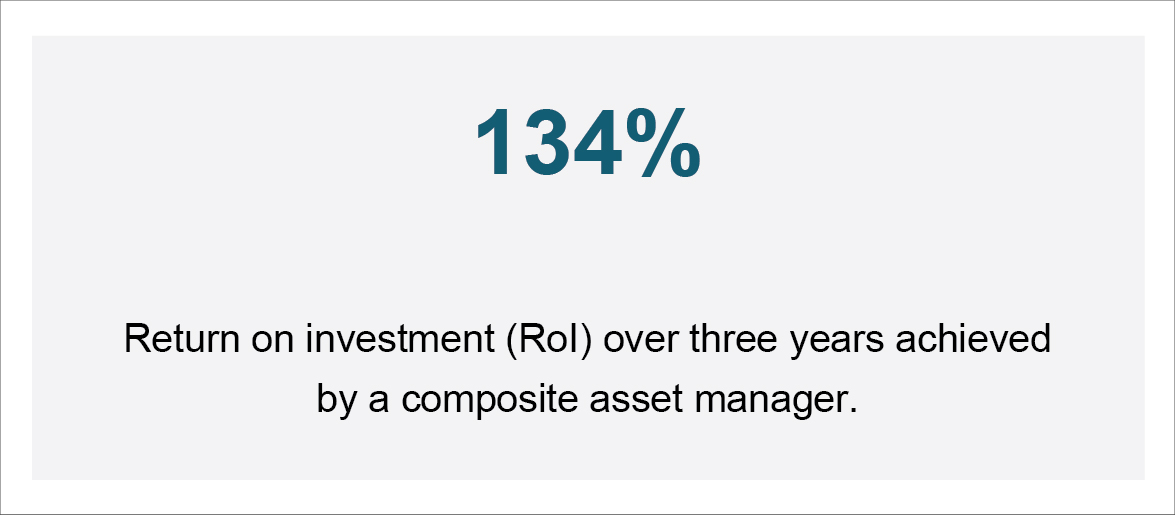
The cost of inaction is not hypothetical; it is visible in the data already cited. The Total Economic Impact, 2024, study found that a composite asset manager operating on a legacy architecture was carrying $11.5 million in addressable operational inefficiency annually, required three additional legacy systems to perform functions an integrated platform handles natively and was absorbing 135,200 hours of avoidable staff effort over a three-year period.
And this was before accounting for the harder-to-measure costs of NAV errors, missed voluntary elections and investment decisions made on imperfect position data. These figures represent what one organization chose to measure. Most firms have not yet done that calculation.
Source: Achmea IM Case Study

How asset managers get there
The path to an exception-based operating model does not require building proprietary technology. PGGM and Achmea implemented established third-party investment management platforms, in the same category as industry tools such as BlackRock’s Aladdin and Charles River IMS. Asset managers license, configure and implement these tools. The technology exists. The challenge is not finding it, but the implementation, integration and continued operational discipline required to make it work at scale.
In practice, the journey involves four stages:
- Consolidating corporate action data feeds across custodians and market data vendors into a single normalised input
- Configuring the platform’s event processing rules to match the firm’s portfolios, instruments and accounting requirements
- Integrating the output cleanly into downstream systems, such as portfolio accounting, risk and client reporting
- Establishing the exception management workflow that defines what the operations team reviews and what processes automatically.
Each stage requires a combination of data expertise, operational knowledge and technology integration capability that most asset management firms do not have sitting idle internally, particularly during a live implementation alongside ongoing business operations.
Where we come in
The transition to an exception-based corporate actions model is not simply a technology decision, but an operational transformation. The firms that navigate this transformation successfully combine the right platform with the right implementation expertise and take a clear-eyed view of their own data landscape before a single configuration decision is made.
Our buy-side practice works with asset managers at each stage of this journey. For firms evaluating the build, we bring the domain knowledge to define what a target operating model should look like: what to automate, where exceptions genuinely require human judgment and how corporate action data needs to flow into portfolio accounting, risk and reporting systems downstream.
For firms in the middle of implementation, we provide the specialist operational and data expertise needed to accelerate delivery and avoid the configuration decisions that create technical debt later. And for firms that need the outcome before the platform investment is ready, our managed service provides the operational architecture of an exception-based model as a fully supported, scalable service.
Our value is in the combination of buy-side operational knowledge, data expertise across custodian and vendor feeds and implementation experience across the platform’s asset managers are using. The result is a faster path to a cleaner corporate actions operation. And a data foundation that pays returns across the entire investment function.
The question worth asking
Asset management firms have, broadly, two options. They can continue optimizing within the existing model, with better tools, more oversight and faster manual resolution. But that path has a ceiling and for many firms it is already visible. Or they can rebuild the architecture.